Skin Overcare Assessment Tool
How many skincare products do you use daily?
Based on your current routine, this tool will assess your risk of skin overcare and suggest what to simplify.
Your Skin Overcare Assessment
Your Skin's Potential Benefits
After 2 weeks: Reduced oiliness, fewer breakouts, less redness
After 4 weeks: Smoother texture, smaller-looking pores, more resilient skin
After 6 weeks: Improved clarity, reduced sensitivity, better barrier function
It sounds backwards, doesn’t it? You spend months layering serums, toners, creams, and oils-only to wake up one day and realize your skin looks clearer, calmer, and more even than ever. And guess what? You didn’t add anything new. You just stopped.
That’s not a coincidence. It’s called skin overcare. And it’s more common than you think.
For years, we were told that more is better. Cleanse twice a day. Tone. Exfoliate. Apply vitamin C. Follow with retinol. Moisturize. Sunscreen. Night cream. Eye cream. Mask twice a week. And if you miss one? You’re sabotaging your glow. But here’s the truth: your skin doesn’t need half of what you’re putting on it. In fact, too much can break it.
Your skin has its own system
Your skin isn’t a blank slate waiting for products to fix it. It’s a living, breathing, self-regulating organ. It produces its own oils, sheds dead cells, repairs damage, and balances moisture-all without you lifting a finger. When you stop interfering, it often goes back to doing what it’s meant to do.
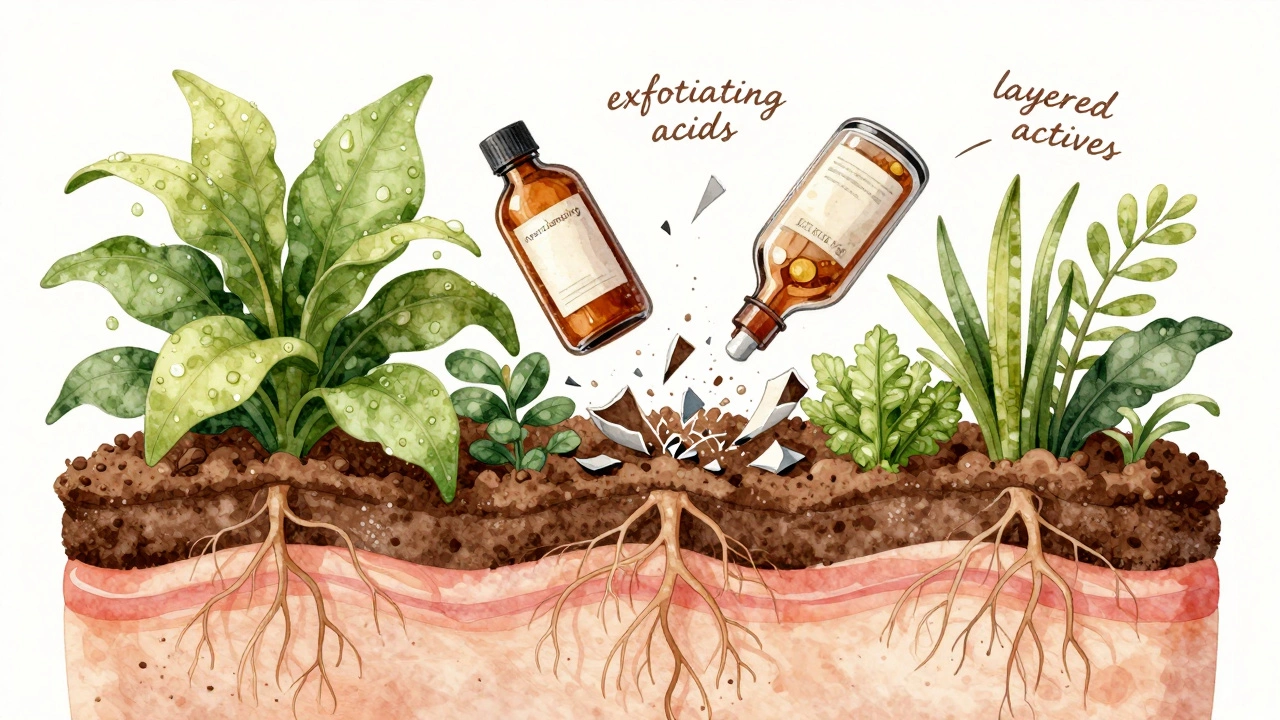
Think of it like a garden. If you keep digging it up, adding fertilizer every day, spraying pesticides, and pulling weeds before they even sprout, the soil loses its rhythm. Eventually, nothing thrives. Your skin is the same. Constant cleansing strips natural oils. Over-exfoliating damages the barrier. Too many active ingredients confuse your cells. And when that happens, your skin goes into survival mode: dry, red, reactive, or oily.
What happens when you stop
When you stop using skincare, your skin doesn’t panic. It recalibrates. Here’s what usually happens in the first few weeks:
- Week 1: You might feel dry or tight. Some people break out. This isn’t a "purge"-it’s your skin adjusting to not being stripped or flooded every day.
- Week 2-3: Oil production slows. Your skin realizes it doesn’t need to overproduce to compensate for harsh cleansers.
- Week 4: Redness fades. Texture smooths. Pores look smaller-not because they’re shrinking, but because they’re not clogged with product buildup.
A 2023 study from the University of Cape Town tracked 120 people who stopped all skincare for 30 days. 68% reported improved skin clarity. 52% said their skin felt "more resilient." And 41% noticed fewer breakouts-despite not changing their diet, sleep, or stress levels.
The products you don’t need
Not all skincare is bad. But most of us are using products we don’t need. Here are the usual suspects:
- Multiple cleansers: One gentle wash a day is enough. Double cleansing? Only if you’re wearing heavy makeup or sunscreen. Otherwise, you’re just removing your skin’s natural moisture.
- Exfoliating scrubs and acids daily: Your skin sheds naturally. Aggressive exfoliation damages the barrier, leading to irritation and sensitivity.
- Layering actives: Vitamin C + retinol + niacinamide + AHA/BHA? That’s not a routine-it’s a chemical warzone. Your skin can’t process all of them at once. It’s like trying to run five apps on a phone with 1GB of RAM.
- Heavy creams and oils: If your skin isn’t dry, you don’t need to smother it. Many creams trap bacteria, clog pores, and trigger fungal acne.
Here’s what most people actually need: water, a mild cleanser (if you feel greasy), and sunscreen. That’s it.
What about hydration?
You might be thinking: "But my skin is dry!" That’s not always a lack of moisture. Often, it’s a broken barrier. When your skin’s outer layer gets damaged-by overwashing, harsh ingredients, or environmental stress-it can’t hold water. So you apply more cream. But the cream doesn’t fix the barrier. It just sits on top.
Instead of layering moisturizers, try this: use warm water to wash your face. Pat dry. Wait 30 seconds. Then apply a single drop of a simple oil-like jojoba or squalane-if you feel tightness. That’s it. No serums. No lotions. Just enough to remind your skin it’s okay to repair itself.
Real people, real results
In Durban, where humidity swings between sticky and dry, I’ve seen this play out again and again. A woman in her 40s stopped using 12 products and switched to just water and sunscreen. Within six weeks, her lifelong acne scars lightened. A man in his 30s, who’d been using 10 different treatments for rosacea, noticed his redness vanished after two weeks of doing nothing.
One client, a teacher in Umhlanga, told me: "I thought I was being careful. Turns out, I was suffocating my skin." She started washing with cool water in the morning and only using SPF 30. Her skin hasn’t looked this clear since her teens.
When to restart-and how
You don’t have to stay off skincare forever. The goal isn’t to go naked. It’s to find balance. After a break, ask yourself: "What was I trying to fix?"
- If you had acne? Try one low-dose retinoid (like adapalene) every other night. Skip the toner, the serum, the scrub.
- If you were dry? Stick to one hydrating ingredient: hyaluronic acid. Use it on damp skin. Then seal with one drop of oil.
- If you’re sensitive? Skip fragrance. Skip alcohol. Skip anything with "anti-aging" or "brightening" in the name. Just water and sunscreen.
And always, always use sunscreen. Even if you’re not using anything else. UV damage is the #1 cause of aging, dark spots, and skin cancer. No product replaces it.
It’s not about products. It’s about trust.
Your skin is smarter than you think. It’s been working for 30,000 years without face creams. It doesn’t need your help. It just needs space.
Most of us treat our skin like a project we can optimize. But skin isn’t a project. It’s a relationship. And sometimes, the best thing you can do is stop trying to fix it.
Try this: go three weeks without anything but water and sunscreen. Don’t look for miracles. Just notice. Is it softer? Less irritated? Less shiny? Less reactive? If yes-you didn’t need all those products. You just needed to let your skin breathe.