Home Gym Equipment Estimator
Your Setup
Recommended Setup
Enter your details to see what equipment fits your space and budget.
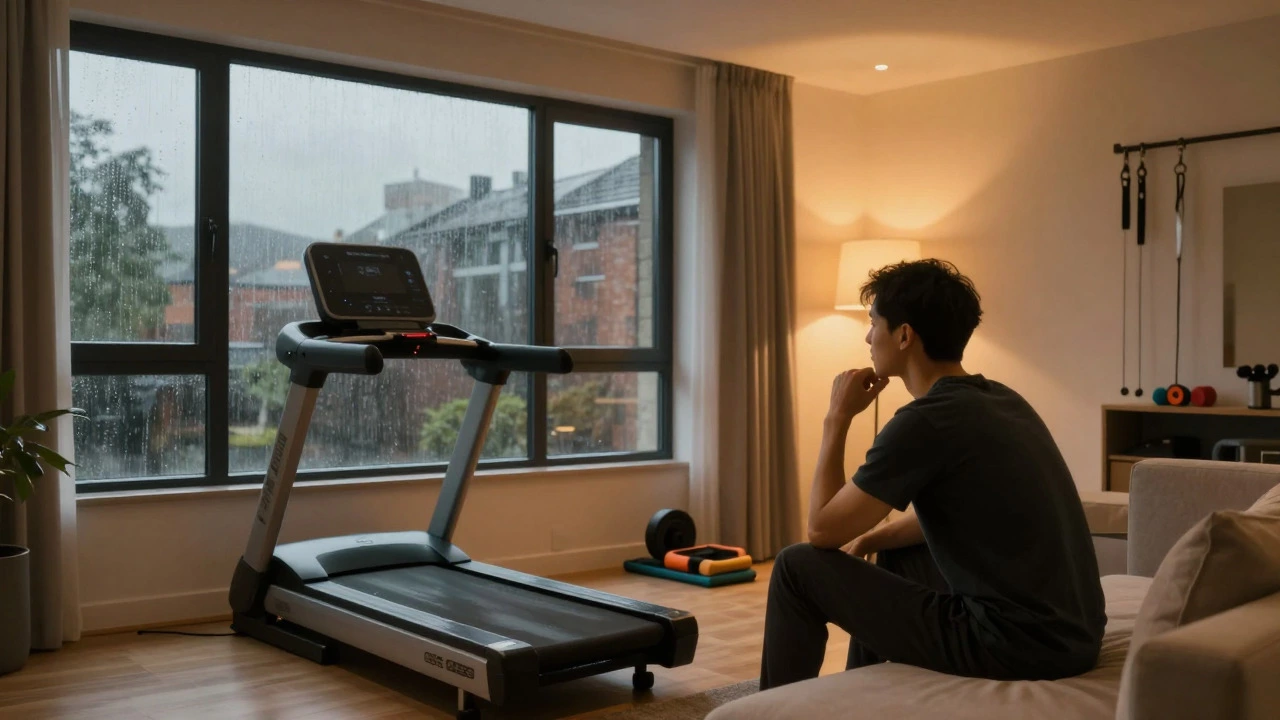
Picture this: you’re sitting on the couch in Durban, watching the rain lash against the windows. The thought of driving to a crowded gym feels exhausting. You look at that dusty treadmill or resistance band kit in the corner and wonder, "Is this actually enough?" Can you really build a strong, healthy body just by interacting with machines at home?
The short answer is yes. Absolutely. But there’s a catch. It isn’t about buying the most expensive gadget; it’s about understanding how those machines interact with your muscles. If you treat a machine like a piece of furniture, nothing happens. If you treat it like a tool for progressive overload, you transform.
Why Machines Are Actually Great for Building Fitness
We’ve been conditioned to think that real strength comes from lifting heavy iron plates with shaky hands. While free weights have their place, home workout equipment designed around fixed paths offers something unique: safety and isolation.
When you use a leg press machine or a chest fly station, the path of motion is predetermined. This means you don’t need a spotter. You can push closer to failure without worrying about dropping weight on your neck. For beginners or people returning to fitness after injury, this stability is gold. It allows you to focus entirely on the muscle contraction rather than balancing the load.
Machines also excel at targeting specific muscle groups. Want to isolate your rear delts without your traps taking over? A reverse pec deck makes that easy. In a traditional gym setting, achieving that level of isolation requires significant technique mastery. At home, the machine does the technical work for you, letting you pour energy into the effort itself.
The Core Principle: Progressive Overload
Here is the secret sauce that separates people who stay the same from those who change. It doesn’t matter if you are using a $50 resistance band or a $5,000 cable crossover system. Your body only adapts if you make the task harder over time. This concept is called progressive overload.
If you do 10 reps of a seated row with 20kg today, and you do the exact same thing next month, your body has no reason to grow stronger. To get fit using machines, you must systematically increase the demand. You can do this in three ways:
- Increase Resistance: Add more weight plates or switch to a heavier resistance band.
- Increase Volume: Do more sets or more repetitions per set.
- Decrease Rest Time: Keep the intensity high by shortening the breaks between sets.
Without tracking these variables, even the best home gym equipment becomes useless. Grab a notebook or a simple app. Log your workouts. If you aren't seeing numbers go up over weeks and months, you aren't getting fitter-you're just maintaining.
Cardio Machines: More Than Just Burning Calories
Let’s talk about the big ones: treadmills, stationary bikes, and ellipticals. Most people view these as calorie burners, but they are vital for cardiovascular health. A strong heart pumps blood more efficiently, which improves recovery between strength sets and boosts overall energy levels.
A treadmill allows for precise control over speed and incline. Walking at a 10% incline burns significantly more calories than walking flat and engages your glutes and hamstrings more deeply. A stationary bike is low-impact, making it perfect for days when your joints are sore from lifting. The key here is consistency. Thirty minutes of moderate-intensity cardio, three times a week, will dramatically improve your endurance and lung capacity.
Don’t ignore the elliptical either. It provides a full-body workout if you engage the moving arms, offering a smooth motion that protects your knees while still elevating your heart rate. For someone living in an apartment where noise might be an issue, a quiet elliptical or a magnetic-resistance bike is often a better neighbor-friendly choice than a pounding treadmill.
Strength Training Without Free Weights
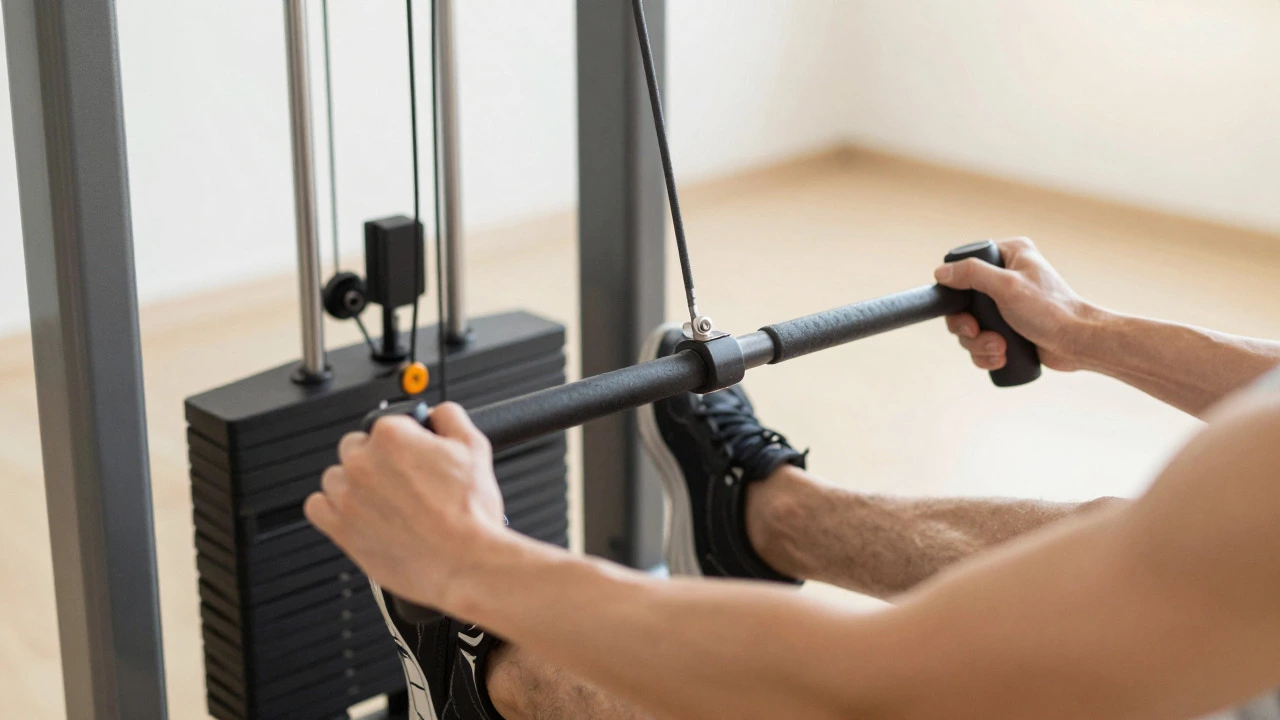
You don’t need a rack of dumbbells to build impressive muscle. Modern home gyms often feature selectorized pin-loaded machines or versatile cable systems. These tools allow you to hit every major muscle group effectively.
For legs, a squat machine or leg press handles the heavy lifting (literally). You can load up safely and drive through your heels to build quadriceps and glute strength. For the upper body, a lat pulldown machine is essential for back width, while a chest press machine builds pushing power. Calf raise machines ensure you don’t neglect the lower legs, which are crucial for balance and metabolic health.
Cable machines are particularly valuable because they provide constant tension throughout the movement. Unlike free weights, where gravity dictates the resistance (making the middle of a bicep curl the hardest part), cables pull against you equally at every angle. This leads to better muscle activation and potentially faster growth.
| Machine Type | Primary Benefit | Best For | Space Requirement | ||||
|---|---|---|---|---|---|---|---|
| Treadmill | High-calorie burn, bone density | Runners, HIIT enthusiasts | Large footprint | ||||
| Stationary Bike | Low impact, joint-friendly | Recovery days, cycling fans | Compact | Leg Press/Squat | Heavy lower body loading | Building leg strength safely | Medium to Large |
| Cable Crossover | Versatility, constant tension | Full-body strength training | Medium | ||||
| Resistance Bands | Portability, variable resistance | Travel, small spaces | Minimal |
The Limitations: What Machines Can't Do
While you can certainly get fit using machines, there are gaps. Machines stabilize the load for you, which means your stabilizer muscles-the smaller muscles that keep your joints safe during complex movements-get less work. This is why incorporating some bodyweight exercises like planks, push-ups, or lunges is wise, even if you primarily use machines.
Another limitation is variety. A home setup usually has fewer options than a commercial gym. You might not have a specialized machine for every single muscle fiber. However, compound movements (exercises that use multiple joints) cover most bases. A chest press works the chest, shoulders, and triceps. A lat pulldown hits the back and biceps. You don’t need 50 different machines; you need five or six well-chosen ones used intelligently.
Creating a Routine That Works
To maximize results, structure your week. Don’t just wander into your home gym and hope for the best. Here is a simple split:
- Monday: Upper Body Strength (Chest press, Lat pulldown, Shoulder press)
- Tuesday: Cardio Interval Training (Treadmill or Bike: 30 seconds hard, 90 seconds easy)
- Wednesday: Lower Body Strength (Leg press, Leg curls, Calf raises)
- Thursday: Active Recovery (Light walk or stretching)
- Friday: Full Body Circuit (Combine upper and lower body moves with minimal rest)
- Saturday/Sunday: Rest or Light Activity
This routine ensures you hit every muscle group twice a week, which research suggests is optimal for hypertrophy (muscle growth) and strength gains. Adjust the volume based on your recovery ability. If you’re constantly sore, take an extra rest day. Fitness is a marathon, not a sprint.
Nutrition: The Missing Link
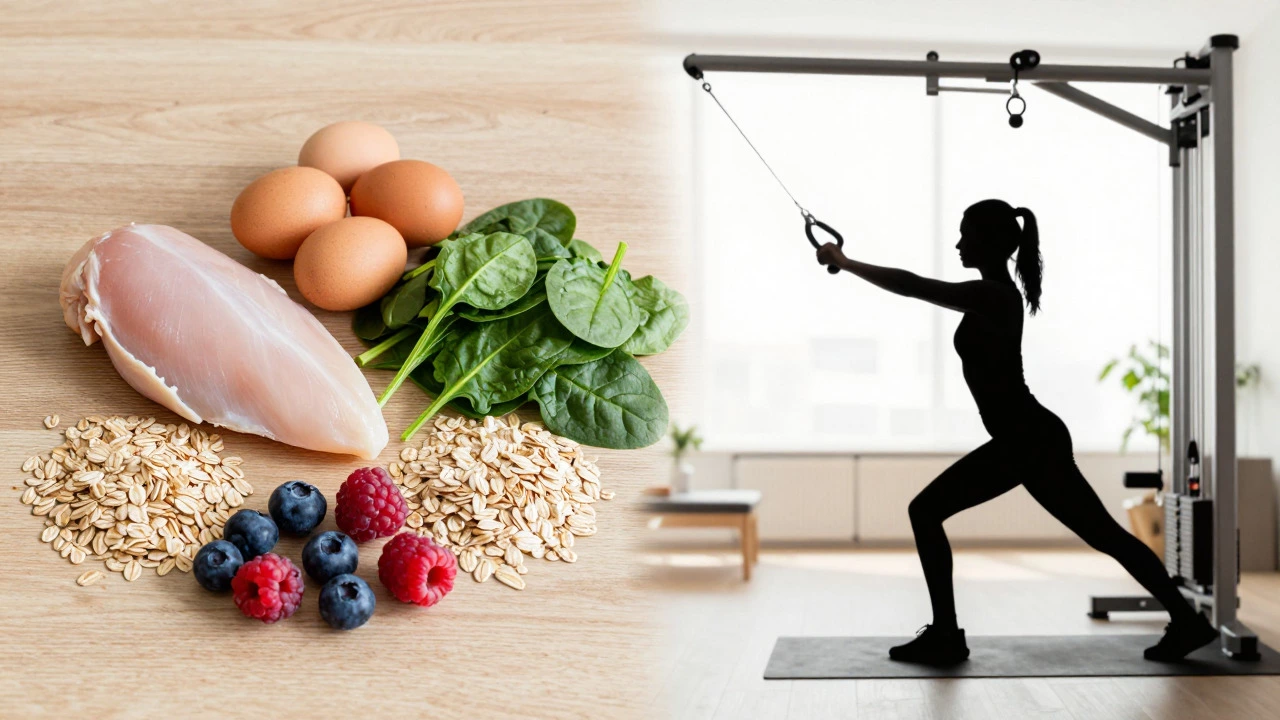
You can train perfectly on your machines, but if your diet is off, progress stalls. Muscle repair requires protein. Aim for roughly 1.6 to 2.2 grams of protein per kilogram of body weight daily. Include lean meats, eggs, beans, or tofu in your meals. Carbohydrates fuel your workouts, so don’t shy away from oats, rice, or fruits before training. Hydration is critical too; even mild dehydration reduces strength and endurance.
Remember, getting fit is 70% nutrition and 30% training. The machines provide the stimulus, but food provides the building blocks.
Overcoming the Mental Barrier
Working out alone at home lacks the social pressure of a gym class. No one is watching you sweat. This freedom can become a trap. Discipline replaces motivation. Set specific goals. Maybe it’s running a 5K, lifting a certain weight, or simply feeling more energetic. Track your progress visually. Seeing a graph of your squat weight climb over three months is incredibly motivating.
Also, create a dedicated space. If your equipment is hidden in a closet, you won’t use it. Keep it visible. Make your home gym inviting. Good lighting, maybe a playlist, and comfortable clothing make a difference. Treat your home workout time with the same respect as a meeting or an appointment.
Can I build muscle without free weights?
Yes, absolutely. Machines provide the necessary resistance to stimulate muscle growth. As long as you apply progressive overload by increasing weight or reps over time, your muscles will adapt and grow. Many bodybuilders use machines exclusively for certain phases of their training to target specific muscles safely.
How much space do I need for effective home workout equipment?
It depends on the equipment. A basic setup with resistance bands and a yoga mat takes up very little space. A full-size treadmill or multi-gym requires a dedicated room or large garage area. Look for foldable treadmills or compact air bikes if space is limited. Ensure you have enough clearance around the machine for safe movement.
Are home gym machines worth the investment?
If you commit to using them regularly, yes. Consider the cost of gym memberships over five years versus the one-time purchase price of quality equipment. Home gyms offer convenience, saving time on travel and waiting for equipment. They pay for themselves if you avoid gym fees and prioritize your health consistently.
What is the best machine for beginners?
A stationary bike or an elliptical is excellent for beginners due to low impact and ease of use. For strength, a selectorized pin-loaded machine or adjustable dumbbells are great starting points. They offer guided movements or manageable increments, reducing the learning curve and risk of injury associated with complex barbell lifts.
How often should I use my home gym equipment?
Aim for 3 to 5 sessions per week. Consistency is key. Split your workouts between strength training and cardio to allow muscles adequate recovery time. Listening to your body is important; rest days are when your body repairs and strengthens itself. Overtraining can lead to burnout or injury.