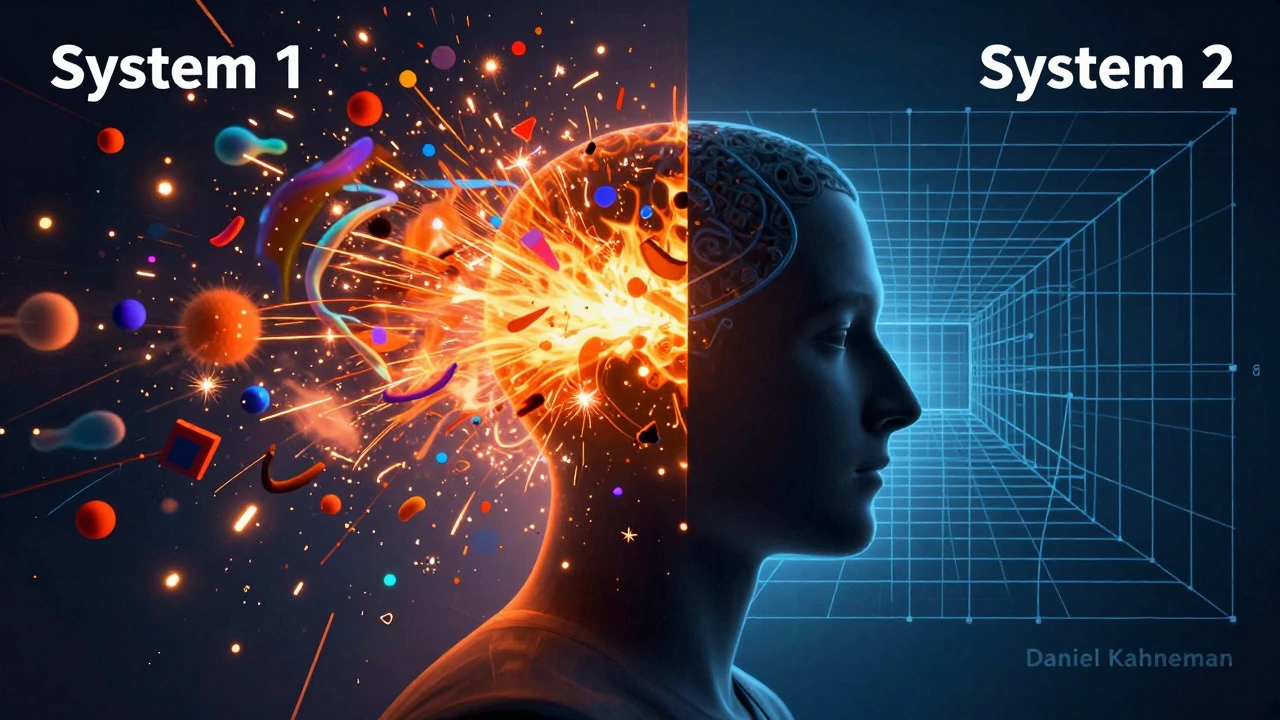
Which Thinking System Are You Using?
Loading question...
Why this matters:
Quiz Complete!
Here's how well you understand your thinking systems
System 1 Dominance
Quick, intuitive decisions that may contain biases
System 2 Engagement
Deliberate, analytical thinking that catches errors
Have you ever bought something on impulse only to regret it an hour later? Or maybe you’ve walked into a room and completely forgotten why you’re there. We’ve all been there. But what if I told you that your brain is actually running two different operating systems at the same time? One is fast, emotional, and instinctive. The other is slow, logical, and effortful. This isn’t just a quirky observation; it’s the core premise of Thinking, Fast and Slow, the groundbreaking book by Nobel laureate Daniel Kahneman.
Since its publication in 2011, this book has become a staple in business bookshelves, psychology classrooms, and self-help circles. But here’s the thing: it’s not exactly a light beach read. It’s dense, packed with decades of research, and requires some patience. So, before you add it to your cart or borrow it from the library, let’s figure out if it’s actually right for you. Who really benefits from reading this, and who might want to skip it?
The Core Idea: System 1 vs. System 2
To understand who should read this book, you first need to know what you’re getting into. Kahneman divides our thinking into two modes. He calls them System 1 and System 2. System 1 is automatic. It’s what lets you detect anger in a voice or complete the phrase "bread and..." without trying. It’s fast and efficient, but it’s prone to errors and biases.
System 2 is the lazy one. It handles complex calculations, parking in a tight spot, or filling out tax forms. It requires focus and energy. Because System 2 is lazy, it often lets System 1 drive the car, leading to mistakes we don’t even realize we’re making. The book explores how these two systems interact, clash, and sometimes deceive us. If you’re curious about why humans make irrational decisions despite having access to facts, this is the manual for your mind.
Who Will Benefit Most from This Book?
Not every reader will get the same value out of Kahneman’s work. Here are the specific groups who will find this book transformative.
Business Leaders and Managers
If you make hiring decisions, set budgets, or lead teams, this book is essential. Why? Because managers are human too. You’re susceptible to the halo effect, where one positive trait (like being well-dressed) makes you assume someone is competent in everything. You might fall for confirmation bias, seeking out data that supports your gut feeling while ignoring red flags.
Kahneman provides tools to recognize these traps. For example, he discusses how to structure interviews to reduce bias, such as asking standardized questions rather than open-ended ones. If you want to make better strategic choices and avoid costly errors in judgment, this book offers a roadmap.
Investors and Financial Planners
The financial world runs on predictions, and predictions are notoriously hard. Kahneman introduces the concept of narrative fallacy-our tendency to create simple stories to explain past events. We think we understood the market crash because we can tell a story about it, but in reality, it was chaos.
He also tackles overconfidence. Investors often believe they have more control over outcomes than they do. By understanding the role of luck versus skill, you can adjust your expectations and build more resilient portfolios. If you’re tired of chasing hot tips and want to understand the psychology behind market bubbles, this is your guide.
Data Scientists and Analysts
Data doesn’t lie, but people interpreting data do. Analysts often suffer from inside view thinking, focusing too much on the specifics of their current project while ignoring base rates (historical averages). Kahneman argues for the outside view: looking at similar cases in the broader context to make more accurate forecasts.
For anyone working with statistics, this book bridges the gap between raw numbers and human behavior. It helps you design studies that account for cognitive biases, ensuring your insights are robust and actionable.
Anyone Interested in Self-Improvement
You don’t need a corporate title to benefit from this. If you’re someone who wants to understand why you procrastinate, why you hold onto losing stocks too long, or why you judge others harshly but yourself leniently, this book offers deep insights. It’s a mirror held up to your own mind. Reading it might be uncomfortable, but it’s incredibly empowering once you start recognizing your own mental shortcuts.
Who Might Want to Skip It?
Let’s be honest. This book isn’t for everyone. If you’re looking for quick fixes, bullet-point lists, or motivational platitudes, you’ll likely bounce off this text within the first chapter. It’s academic in nature. Kahneman writes clearly, but he doesn’t dumb things down. There are no charts summarizing every bias. You have to engage with the arguments.
If you’re easily bored by detailed descriptions of psychological experiments, this might feel like homework. Also, if you prefer actionable "how-to" guides over theoretical frameworks, you might find the lack of step-by-step instructions frustrating. This book explains why we think the way we do, not necessarily how to fix every single issue in a weekend.

Key Concepts You’ll Encounter
To give you a taste of what’s inside, here are some of the most impactful ideas Kahneman explores:
- Anchoring Effect: How initial information influences subsequent judgments. For example, if you see a shirt priced at $100, a $50 shirt seems cheap. If you saw it at $30 first, $50 seems expensive.
- Loss Aversion: The pain of losing is psychologically about twice as powerful as the pleasure of gaining. This is why we hold onto bad investments hoping they’ll break even.
- Framing Effect: How the presentation of information changes our choice. Would you prefer a surgery with a 90% survival rate or a 10% mortality rate? Same stats, different feelings.
- Prospect Theory: Kahneman’s model of how people choose between probabilistic alternatives involving risk. It challenges traditional economic theories that assume humans are rational actors.
| Feature | System 1 (Fast) | System 2 (Slow) |
|---|---|---|
| Speed | Rapid, automatic | Deliberate, effortful |
| Energy Use | Low | High |
| Prone To | Bias, error, illusion | Fatigue, distraction |
| Example | Detecting hostility | Parking in a narrow space |
How to Approach the Book
If you decide to pick it up, here’s some advice. Don’t rush. Take notes. When Kahneman describes an experiment, pause and ask yourself, "When have I experienced this?" Personal reflection turns abstract theory into practical wisdom. Consider discussing it with a friend or colleague. Talking through concepts like the sunk cost fallacy helps solidify your understanding.
Also, remember that Kahneman himself acknowledges that his earlier work was overly focused on errors. In later years, he emphasized that System 1 is generally adaptive and useful. The goal isn’t to eliminate System 1 but to know when to engage System 2. Keep this balance in mind as you read.
Alternatives to Consider
If Thinking, Fast and Slow feels too heavy, there are lighter alternatives that cover similar ground. Nudge by Richard Thaler and Cass Sunstein applies these principles to public policy and everyday choices in a more accessible way. Predictably Irrational by Dan Ariely uses entertaining experiments to show how we deviate from rationality. Both are great entry points if you want the insights without the academic depth.
Final Thoughts
So, who should read Thinking, Fast and Slow? Anyone who wants to understand the machinery of their own mind. It’s a challenging read, but the payoff is profound. You’ll start noticing biases in news headlines, advertising, and your own daily decisions. It won’t make you perfect, but it will make you aware. And in a world full of noise, awareness is the first step toward clarity.
Is Thinking Fast and Slow easy to read?
It depends on your background. If you enjoy psychology or economics, you’ll find it engaging. However, it is dense and academic. It lacks the punchy style of modern pop-psychology books. Expect to slow down and re-read sections.
What is the main takeaway from the book?
The main takeaway is that humans are not as rational as we think. We rely on mental shortcuts (heuristics) that often lead to systematic errors. Recognizing these biases allows us to make better decisions by engaging our slower, more logical thinking mode.
Who is Daniel Kahneman?
Daniel Kahneman is a psychologist and economist who won the Nobel Prize in Economic Sciences in 2002. He is known for his work on prospect theory and cognitive biases, which challenged the traditional economic assumption that humans are always rational.
Should I read Nudge or Thinking Fast and Slow first?
If you are new to behavioral economics, start with Nudge. It is more accessible and practical. Thinking, Fast and Slow is the foundational text that explains the science behind the nudges. Read Kahneman after you have a basic interest in the topic.
Does the book provide solutions to biases?
It focuses more on identifying biases than providing step-by-step cures. However, by understanding the mechanisms, you can implement debiasing techniques like checking base rates, seeking disconfirming evidence, and slowing down your decision-making process.